
Most leadership assessments focus on one question:
How is this person wired to think, decide, and interact?
That's useful, but it's not what determines effectiveness in real organizations.
The real question is:
How is this person actually operating at work, what is it costing them, and is it sustainable?
Because what you see in the workplace isn't just how someone is wired.
It's how they've adapted.
And that distinction changes how organizations should build their leadership pipelines.
The Problem with Most Leadership Assessments
Traditional assessments measure personality, preferences, or behavioral tendencies.
They tell you:
- how someone is wired
- how they prefer to communicate
- how they tend to make decisions
That's valuable - but incomplete.
Because in most organizations, people don't operate purely from their natural tendencies.
They adapt.
To their leader. To their team. To the culture. To what gets rewarded.
And over time, that adaptation becomes what others experience as "their leadership style."
Which means most organizations are making talent decisions based on adapted behavior - not true capability.
The Nature–Nurture Distinction
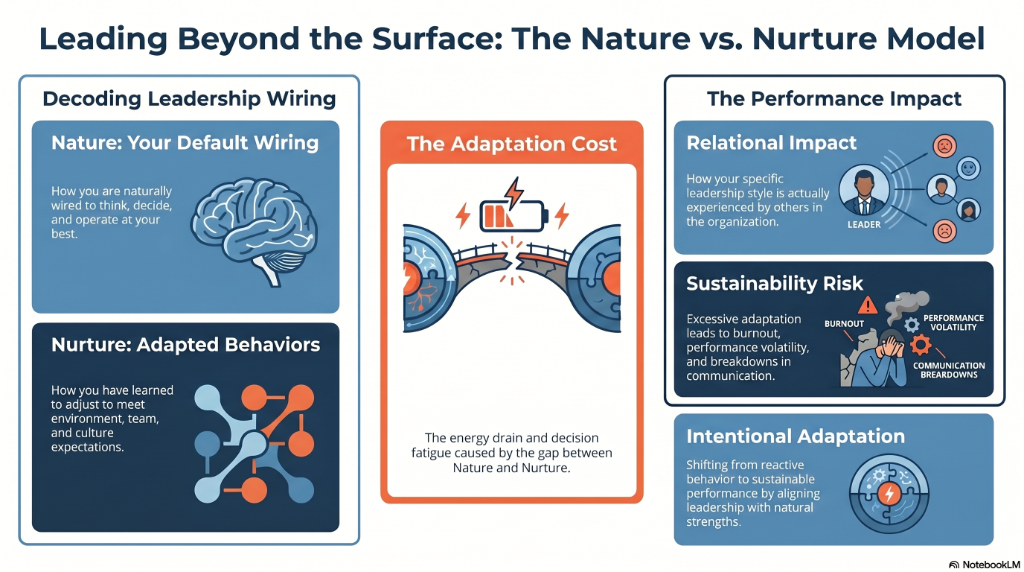
The Nature–Nurture model separates two critical dimensions:
Nature
A person's default wiring - how they naturally think, decide, and operate.
Nurture
How they've learned to adapt based on expectations, environment, and experience.
This distinction isn't theoretical.
It shows up in everyday leadership behavior.
The same leader may be:
- direct by nature, but softened in communication
- fast-moving, but slowed down by process expectations
- independent, but operating in a highly collaborative environment
What you see is the adaptation.
Not the default.
Why This Matters for Leadership Pipelines
Most leadership pipelines are built on:
- performance
- potential
- competency models
But they often miss a critical dimension:
sustainability of how a leader is operating.
When organizations don't distinguish between nature and nurture, they risk:
- promoting leaders based on adapted behavior that isn't sustainable
- placing leaders into roles that require even more misaligned adaptation
- misdiagnosing performance issues that are actually adaptation strain
This is where strong leaders start to break down, not because they lack capability, but because the cost of how they're operating is too high.
The Hidden Cost: Adaptation
Most assessments stop at behavior.
The Nature–Nurture model goes further.
It measures:
- how much someone is adapting
- how sustainable that adaptation is
- how that adaptation is experienced by others
Because adaptation isn't free.
It creates:
- energy drain
- decision fatigue
- inconsistency under pressure
- breakdowns in trust and communication
Over time, this shows up as:
- burnout risk
- reduced leadership effectiveness
- volatility in performance
What looks like a capability gap is often an adaptation gap.
The Culture Connection
Leadership behavior is not created in isolation.
It is shaped - and reinforced - by culture.
Culture defines:
- what behaviors are expected
- what gets rewarded with pay increases and promotions
- what gets corrected or ignored
Which means culture doesn't just influence leadership.
It drives how leaders adapt.
When culture and leadership expectations are clear and aligned, adaptation becomes:
- intentional
- consistent
- sustainable
When they're not, adaptation becomes:
- reactive
- inconsistent
- exhausting
The Culture Timing Insight
Leadership effectiveness follows the same principle as any transformation:
Transformation Success = Leadership × Culture × Capability
The Nature–Nurture model strengthens each component:
- Leadership: clarifies how leaders actually show up vs how they intend to
- Culture: reveals what behaviors the environment is reinforcing
- Capability: builds the ability to adapt intentionally - not reactively
When these align, leadership pipelines produce consistent, scalable results.
When they don't, friction increases, especially as leaders move into more complex roles.
What Your Assessment Is Actually Measuring
A Nature–Nurture assessment isn't just identifying personality.
It's measuring three critical dimensions:
1. Default Tendencies (Nature)
How someone is wired to operate at their best.
2. Adapted Behaviors (Nurture)
How they've adjusted to meet expectations and navigate their environment.
3. Adaptation Cost and Impact
The energy required to sustain that adaptation - and how it affects others.
This third dimension is what most tools miss.
And it's what makes the difference between short-term performance and long-term leadership effectiveness.
Rethinking Leadership Development and Placement
When organizations apply a Nature–Nurture lens, leadership decisions change.
Instead of asking:
- "Is this person performing well?"
They ask:
- "How are they achieving that performance - and is it sustainable?"
This enables organizations to:
- place leaders into roles aligned with their natural strengths
- identify where adaptation is effective vs where it creates strain
- design development that expands capability without burnout
- build leadership pipelines that scale - without breaking the people in them
From Insight to Action
Insight alone doesn't change outcomes.
What matters is how organizations use it.
High-performing organizations apply Nature–Nurture insights to:
- align leadership expectations with actual behavior
- design targeted, practical development
- build awareness of how leaders are experienced by others
- create more consistent leadership across teams and levels
The goal isn't to eliminate adaptation.
It's to make it intentional, visible, and sustainable.
The Bottom Line
Leadership isn't just how someone is wired.
It's how they operate - shaped by what they've learned, what's expected, and what their workplace culture reinforces.
Organizations that understand both Nature and Nurture don't just assess leaders more accurately.
They build stronger, more sustainable leadership pipelines.
Because when leaders can operate closer to their strengths, while adapting with intention, they perform.