
Most organizations think M&A integration begins after the deal closes.
It doesn't.
By the time Day One arrives, the conditions for success - or failure - have already been set.
Leaders spend months aligning on valuation, synergies, and operating models. But too often, they delay the most critical conversation:
How will this organization actually work once we're one company?
That gap between strategy and behavior is where integration breaks down.
And it shows up fast.
Within the first 90 days, you'll know:
- Whether leaders are truly aligned - or just aligned on paper
- Whether employees understand how to operate in the new environment
- Whether the organization is moving forward - or defaulting to legacy ways of working
This is the M&A Culture Window.
A narrow, high-impact period where behaviors are formed, trust is tested, and adoption either takes hold - or stalls.
Miss it, and integration becomes reactive, slow, and expensive.
Get ahead of it, and change happens with clarity, consistency, and far less friction.
The difference isn't the strategy.
It's whether leaders made the right culture decisions before the deal closed - and entered Day One ready to reinforce them.
The Data Behind M&A Failure
70%-90% of mergers and acquisitions fail to achieve their intended value. This is supported by research from Harvard Business Review and McKinsey & Company.
The primary cause isn't strategy - it's people and culture integration.
Why the First 90 Days Matter More Than the Strategy
Leaders spend months aligning on valuation, synergies, and operating models.
Then the deal closes - and reality shifts.
Teams don't adopt new ways of working. Leaders send mixed signals. Legacy cultures persist.
This is where the Transformation Gap shows up: the gap between announcing change and changing how work gets done.
In M&A, that gap forms immediately - and widens quickly if left unmanaged.
Start Before Day One: Culture Alignment Happens in the Deal Room
Most organizations wait until after the deal closes to address culture.
By then, it's already too late.
The most critical culture decisions aren't operational - they're leadership decisions that must be made during M&A discussions.
Before the deal closes, leaders need to be aligned on a few non-negotiables:
What are the values of the combined organization?
Not a blended list - but a clear, agreed-upon set of values that will actually guide decisions.
How will people be expected to work - differently?
Where will norms shift?
- Decision-making speed
- Collaboration expectations
- Communication style
- Accountability standards
If this isn't explicit, legacy behaviors will fill the gap.
How will systems and ways of working be evaluated?
Leaders must define:
- What gets kept from each legacy organization
- What gets integrated
- What gets retired
And more importantly - how those decisions will be made and communicated.
When and how will people be expected to follow the new model?
Clarity on timing and expectations prevents confusion, resistance, and uneven adoption.
What Actually Breaks During Integration
Post-merger challenges are rarely random. They follow a predictable pattern.
Leadership Drift Leaders align in the deal room - but reinforce different behaviors once integration begins.
Culture Collision Unspoken norms from each organization compete instead of integrate.
Capability Confusion People don't know how to operate in the new environment - or lack the tools and clarity to do so.
Reinforcement Gaps Operating rhythms, decision rights, and accountability systems don't support the new direction.
Individually, these are manageable. Together, they compound - fast.
The Risk of Waiting
When leaders avoid these conversations before close, they don't avoid conflict - they delay it.
And it shows up fast:
- Top talent leaves due to uncertainty or misalignment
- Trust in leadership erodes when messages and actions don't match
- Performance drops as teams revert to legacy ways of working
- Integration becomes reactive instead of intentional
In many cases, leaders look back and realize the issue wasn't the deal.
It was the lack of alignment going into it.
The Culture Timing Insight
Successful integration follows a simple principle:
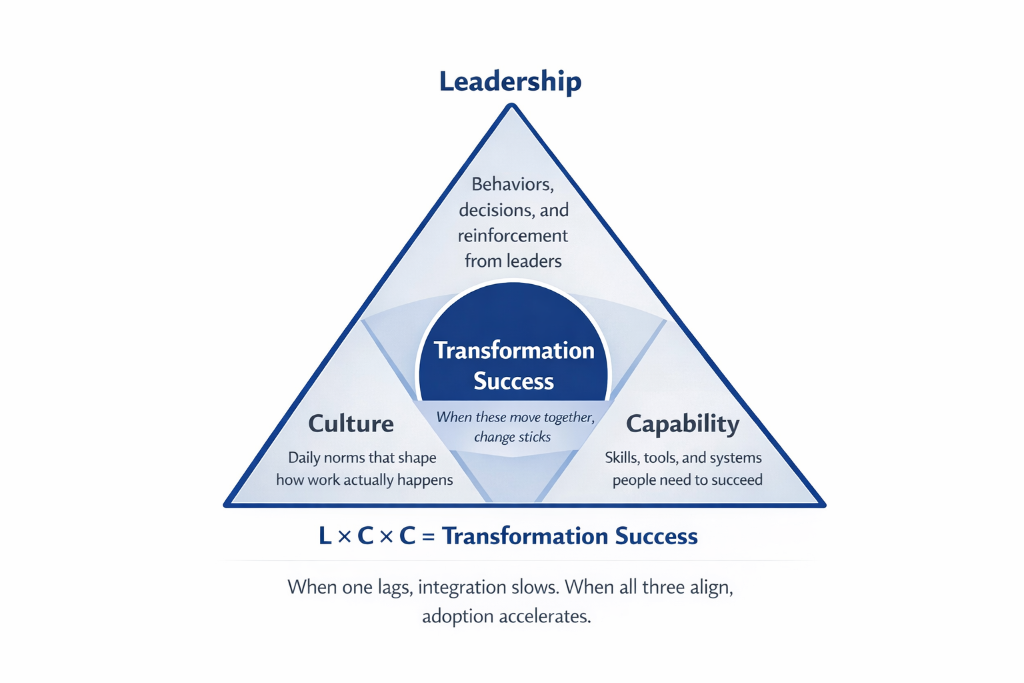
Transformation Success = Leadership × Culture × Capability
When these move together, integration accelerates. When one weakens, momentum stalls.
What "Timing" Actually Means in M&A
Timing isn't about speed.
It's about sequence and alignment.
It's knowing:
- What to align first
- When to reinforce it
- How to build capability before friction sets in
In M&A integration, the most common mistake is doing the right things - but in the wrong order.
For example:
- Rolling out new systems before leaders model new behaviors
- Announcing cultural values without reinforcing them in decisions
- Expecting collaboration before defining how decisions get made
The result: confusion, resistance, and slow adoption.
How to Win the 90-Day Window
Organizations that succeed don't try to do everything at once.
They focus on early alignment that shapes behavior quickly.
Diagnose Culture Signals Early
Understand how each organization actually works - not just what's written down.
Align Leadership Behavior First
Before processes and systems, ensure leaders are reinforcing the same expectations.
Clarify Decision Rights and Operating Rhythms
People need to know how decisions are made and how work flows - immediately.
Build Capability Where It Matters Most
Target the roles and teams under the most pressure to perform.
Reinforce Consistently
What gets rewarded, discussed, and measured becomes the culture.
Where Culture Timing Changes the Outcome
Most integrations treat culture as a downstream activity.
Something to address after systems, org charts, and processes are in place.
That's backwards.
Culture is not a phase of integration. It's the system that determines whether integration works.
A Culture Timing Assessment shifts this approach by identifying:
- Where leadership is aligned - or drifting
- Where cultural friction is likely to occur
- Where capability gaps will slow adoption
- What to prioritize first in the integration sequence
Instead of reacting to problems, organizations can sequence the right interventions at the right time.
The Bottom Line
M&A success isn't decided at deal close.
It's decided in the first 90 days - when people determine how the new organization actually works.
The organizations that win don't just integrate structures.
They align leadership, culture, and capability - early, deliberately, and in the right sequence.
Because when those move together, change doesn't just get announced.
It becomes how work gets done.